


The forest is the perfect place for adventures big and small. It is full of secrets, exciting sounds and surprising discoveries – all ideal conditions for a scavenger hunt! A forest scavenger hunt is a real highlight, especially for birthdays, family outings, children’s groups or school trips. But to make it a success, you need creative, ageappropriate and varied tasks. In this article, we present 25 ideas for successful forest scavenger hunt tasks – from classic to tricky, from nature-based to action-packed.
Nature itself becomes our stage: tree trunks become balancing routes, leaves become clues, and the rustling in the bushes perhaps the trail of a “hidden treasure”… Especially in the age of constant digital sound, an analog discovery tour in the countryside is not only good for children – adults also often rediscover their play instinct here. It’s not just about exercise, but also about observation skills, team spirit and creativity.
Whether you are planning a one-hour mini-tour or an extended treasure hunt with a map, clues and puzzles – with the right selection of tasks, your forest scavenger hunt will be an unforgettable experience. Let our ideas inspire you and find exactly the right tasks for your group and the occasion!
Why a Scavenger Hunt in the Forest?
The forest not only offers a great backdrop, but also lots of free props and opportunities to introduce children (and adults!) to nature in a playful way. A scavenger hunt in the forest encourages:
- Exercise in the fresh air
- Team spirit and cooperation
- Experience nature with all your senses
- Concentration, creativity and orientation
With well thought-out forest scavenger hunt tasks, the adventure is both lively and educational – and guaranteed not to bore anyone.
How Do I Set Up a Good Forest Scavenger Hunt?
Before we get to the tasks, here are a few tips for preparation:
- Planning the route: Mark out a safe, easy-to-walk route through the forest. Pay attention to landmarks.
- Define stations: Place your tasks so that they are clearly visible, but not too conspicuous.
- Choose age-appropriate tasks: Depending on the age group (e.g. 5-7, 8-12, teenagers or adults), the requirements vary.
- Prepare materials: Paper, ropes, pens, natural materials, puzzles or small prizes enrich the experience.
- Keep an eye on the time: Allow enough time for each station (around 5-10 minutes).
25 Creative Forest Scavenger Hunt Tasks
A forest scavenger hunt thrives on variety – and on tasks that suit the surroundings and stimulate the imagination. Ideally, they not only promote teamwork and exercise, but also mindfulness towards nature. The following 25 forest scavenger hunt tasks can be flexibly incorporated into your route and are adaptable for different age groups. When describing the forest scavenger hunt tasks below, I often use the word “children” for the participants of the scavenger hunt, but all of them can of course also be carried out by adults.
Many of the tasks require minimal preparation or can be carried out with few materials. Whether you tell a story about a lost forest treasure or let the children collect points at stations – with these ideas, your forest scavenger hunt is guaranteed to be an adventure!
1. Guess Animal Noises
Prepare a sound recording with different animal sounds in advance – such as birdsong, the croaking of a frog or the bellowing of a deer. The aim is to guess the correct animals. Alternatively, you can imitate the sounds yourself or encourage some children to imitate them while others have to guess.
Especially for younger children, you can also prepare picture cards with the animals as a little help, from which the correct ones must then be selected.
2. Leaf Memory
Many forests in Germany are mixed forests and you can get to know a real variety of different deciduous trees here. Leaf memory is the ideal forest scavenger hunt task to teach children (or adults) about species in a playful way and to sharpen their eye for detail.
Show the scavenger hunt participants five different leaves of native trees (e.g. oak, maple, beech, chestnut, lime) and have them memorize the shapes. Then they go off in small groups to find the same leaves in the forest. Who can recognize them all?
Tip: As a variation, you can of course do the same task with different pieces of bark.
3. Cone Target Throw
Mark a target area on the forest floor with a rope or stones – for example, a circle that you have to hit and a line that you have to stand behind when throwing. The other players then take it in turns to throw pine cones (or other natural materials) at the target.
You can also mark the center of a circle with a stone or branch and define different areas, just like a target. The closer to the center you hit, the more points you get for your cone throw.
If you are playing with a group of particularly skilled throwers, you can also set up a bucket to hit into to increase the difficulty.
4. Sensory Boxes With Natural Materials
This is one of the best forest scavenger hunt tasks that are great for teaching children about the diversity of nature.
Prepare a few small boxes or cloth bags containing different forest materials: e.g. moss, acorns, chestnuts, pine needles, bark. Without looking inside, the children are allowed to put their hands into the boxes one after the other and guess what they are feeling.
This task appeals to the sense of touch and promotes attention and a feeling for language.
5. Tree Trunk Balancing
A tree trunk lying crosswise is perfect for a balance course. Who can walk across it without falling off?
Depending on the age and athletic ability of the group, you can also incorporate small “levels” into this task: e.g. balancing backwards, with your eyes closed or with an object in your hand. This provides exercise and lots of fun!
However, please pay particular attention to safety, for example by always having someone running next to the tree trunk who can support or catch you in case of doubt.
6. Map Skills – Navigating Like a Real Adventurer
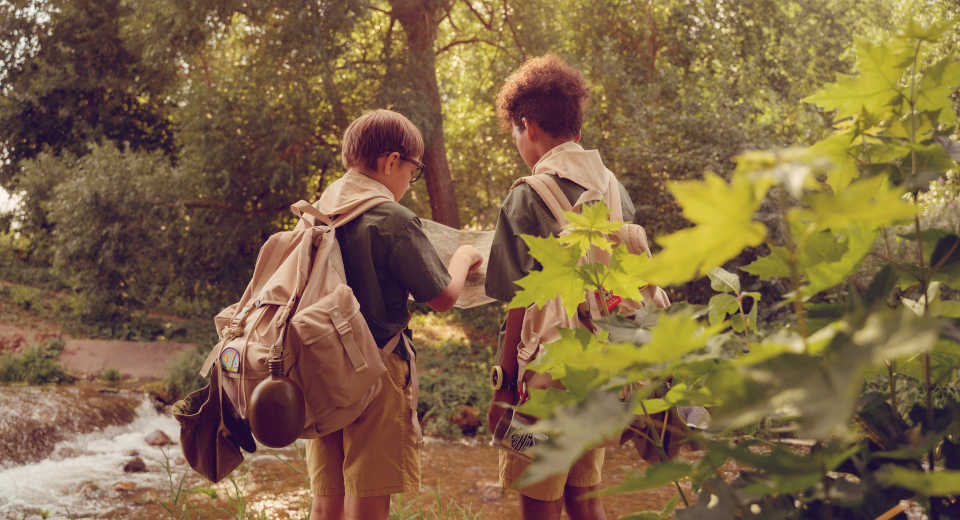
You can add a compass to the task or include small orientation clues. This task encourages spatial thinking and adds a touch of discovery to the scavenger hunt.
7. Recognizing the Smell of the Forest
Prepare small tins, jars or cloth bags and fill them with different natural materials – e.g. pine needles, dried mint, forest soil, spruce cones, moss or lavender. The children are blindfolded and allowed to sniff the tins one by one. The task is to correctly match as many of the smells as possible.
A fragrant station that is particularly relaxing and activates the senses.
8. Animal Quiz
Show the children picture cards or printouts of animals, their tracks, their nests or characteristic features such as feathers, fur, antlers or eggs. The children should guess which forest animal it is. You can also provide brief information about each animal to create a small forest encyclopaedia.
As an extension, you can give short hints such as: “I am nocturnal and love mice.” – Who knows it’s an owl? A great game for little naturalists aged 7 and up.
9. Nature Artwork
Form several groups for this station. Each group collects natural materials such as leaves, moss, stones, pine cones or branches and uses them to create a small work of art on the forest floor. This can be an animal, a mandala or a fantasy world.
After the construction period, the groups present their works of art to each other and tell each other what they had in mind. This creative task stimulates imagination, mindfulness and cooperation.
10. Sound Memory
Two children get together and think of several (3 – 6) nature sounds that can be made with twigs, stones, water or leaves. The other children should not be aware of this at first.
Then the “sound pair” comes back to the others and they all have to close their eyes and be very quiet. First, one child demonstrates all the sounds, for example tapping on a trunk, cracking twigs, rustling leaves or banging two stones against each other, etc. The other children listen carefully and memorize the sounds. Then it’s the other child’s turn to make the same noises, but in a different order!
The listeners now have to say: Which two sounds belong together? This acoustic memory works well in smaller groups and encourages concentration on acoustic impressions in the forest.
11. What Is Missing? – Memory Exercise With Natural Materials
Spread out a cloth on which you lay out 5 to 7 different natural objects – e.g. a pine cone, an acorn, a leaf, a smaller stone, a piece of bark, a feather and a moss cushion. The children are allowed to look closely at the objects for 30 to 60 seconds. Then the cloth is covered again. Secretly remove an object and lift the cloth again.
Now the children should find out: What is missing? You can increase the difficulty by using more objects or only letting them observe for a short time. A great exercise for memory and concentration.
12. The Tree Code – The Secret Message in the Forest
A clue to the next station is hanging on a tree – but not just like that. The message is encrypted! For example, in the form of a picture puzzle, Morse code or rebus (pictures that make words). You can also use a simple cipher in which letters are replaced by symbols. The children have to crack the code to find out where to go next.
This not only stimulates logical thinking, but also turns the forest scavenger hunt into a real adventure with a detective feel.
13. Stream Explorer – Discovery Tour by the Water

Alternatively, you can hide small figures or objects on the shore beforehand.
Important: Pay attention to safety and only do this station if the terrain is suitable. The encounter with water brings a breath of fresh air to the scavenger hunt and stimulates all the senses.
14. Nature Treasure Hunt – The Little Treasures of the Forest
Give the children a creative search list with open-ended tasks such as: “Find something red”, “something round”, “something you find beautiful”, “something with texture”, “something that makes a noise”. They should find these things in the forest and collect them on a cloth or in a basket.
Afterwards, each child (or team) is allowed to present what they have found – with an explanation of why they chose that particular item. This encourages mindfulness and turns the children into real naturalists.
Tip: Please make sure that nothing living or worth protecting is taken away.
15. Playing the Role of an Animal – Move Like a Forest Dweller
Ask the children to transform themselves into different forest animals: “Jump like a frog!”, “Sneak like a fox!”, “Romp like a wild boar!” or “Climb like a squirrel!” You can tell a little story or make a competition out of it (“Who moves best like a deer?”).
This game is particularly popular with younger children, brings a lot of movement into the group and at the same time strengthens their imagination and body awareness.
16. Guess Forest Rhymes – Poetry With a Twist
Read small rhymes to the children that describe an animal, a plant or a natural phenomenon. Example: “I am an animal with red fur, jumping nimbly from branch to branch so fast…” – The solution: the squirrel. The children should guess what it is about.
You can use well-known children’s poems or write your own short rhyming riddles. This game trains listening skills, promotes language skills and brings a calm, mysterious atmosphere to the treasure hunt.
17. Making Words Out of Sticks – Spelling With Natural Materials
The children collect small branches, twigs and sticks in the forest. Together, they should make words out of them – for example, the name of the birthday child, the motto of the scavenger hunt or a forest word such as “moss”, “deer”, “fox” or “adventure”.
Creative fantasy words are also allowed! The words can then be photographed or presented to everyone. This station combines language, creativity and teamwork – and is also a great souvenir of the day.
18. Acorn Race – The Little Forest Course
Use sticks, stones or string to build a small track through which the children have to roll an acorn – using a small stick, not their hands! The aim is to roll the acorn through the course as quickly and accurately as possible without it rolling away. You can take your time or make it a relay. This game is simple but very entertaining and requires skill, concentration and a good sense of proportion.
19. Leaf Long Jump – Who Can Sail the Furthest?
Each child looks for a large leaf – preferably one with a good “flying form”. Then they throw it from a fixed line: Which leaf flies or sails the furthest? It is allowed to fold or tear the leaf, but not to connect it with other materials.
You can also make several rounds, e.g. with different throwing techniques or through light obstacles. A measuring stick or tape measure helps with the evaluation. This game is uncomplicated, works in almost any weather and is guaranteed to bring laughter and enthusiasm.
20. Forest Station With Puzzle – The Brain Break on the Go
A riddle awaits the group at a certain station of the scavenger hunt. This can be a nature riddle (“I have no legs and yet I walk…”) or a logic riddle (“What grows the more you take away? – A hole.”). Depending on the age of the children, you can ask simple questions or read out little stories in which the solution is hidden.
Whoever solves the riddle gets the clue to the next station. This task brings peace and reflection into the game – a nice change from the active stations.
21. Bark Puzzle
Carefully break a larger piece of tree bark into about 2-5 pieces and mix them with other “puzzle pieces” made of other bark. The children have to find out which pieces belong together and put the original piece back together again.
A tricky task for fine motor skills and spatial thinking.
22. Climbing Task – Over Hill and Dale
Find a safe but slightly challenging place in the forest: for example, a sloping slope, a lying tree trunk or a tangle of branches that you can climb through. The children should overcome this mini course – with the help of their hands, good balance and a little courage. You can invent a “mission”: e.g. “Save the squirrel sitting at the top of the tree trunk!”
The important thing is to always ensure safety, with helpers on hand if necessary. This turns the movement into a game – and every child grows a little beyond themselves.
23. Water Transport – Teamwork With the Risk of Dripping

The trick: the cup must not be held by hand, but must be balanced on a spoon or tray. The aim is to spill as little water as possible. A lively game for skill and teamwork!
24. Forest Dominoes – Recognizing Patterns With Natural Materials
Prepare large cardboard dominoes with various nature motifs painted or glued on them – e.g. leaf, cone, tree bark, mushroom, feather. The children should put the dominoes together in the correct order, with one motif matching in each case.
They can then design new dominoes themselves using real materials and create their own domino chain. This game combines creativity with pattern recognition and is particularly suitable for quiet moments.
25th Moss Message – Secret Writing in the Green
Children can use pieces of moss to create letters, symbols or even small messages – e.g. “Welcome”, “Team A” or a heart. You can show an example beforehand or prepare a specific message that needs to be “decoded”. This station is ideal as a creative break or as an introduction to the scavenger hunt. Moss is wonderful to shape, pleasant to the touch – and stimulates the imagination.

Conclusion: With Good Forest Scavenger Hunt Tasks, the Excursion Becomes an Adventure
Whether it’s a children’s birthday party, vacation camp or family weekend – a forest scavenger hunt with well-thought-out tasks brings exercise, excitement and lots of fun. You can easily adapt them to suit the age, group size and time frame and keep redesigning them with creative ideas. And best of all: the forest provides the perfect playing field!
If you don’t have much time to prepare, tasks that don’t require any materials at all will help:
- Count the annual rings of a tree stump together.
- Who will be the first to discover five different mushrooms (without touching them!)?
- Collect as many different grasses as possible in one minute.
- How many cones can you fit in the palm of your hand?
Here at Greatime you will find more articles on the topic of forest scavenger hunts: if you are looking for further inspiration, take a look at…
- These forest games for children and adults
- Our ready-made forest rally with tasks
- and the best campfire games for kids
In our shop you will also find ready-made scavenger hunts as PDFs to print out, as well as games for different age groups and occasions.
Greatime – Your Place for Inspiring Leisure Ideas
Our mission is: get the best out of your free time! Especially the free time we spend with our favorite people, i.e. partners, family and friends is, in our opinion, the most precious thing in the world. With varied activities and exciting adventures, you can create shared memories that will last forever.
We have collected leisure ideas of all kinds for you here, from outdoor excursions to crafting instructions, from party tips to board games. We also have a special focus on the big celebrations in the year and in life: whether Easter or Christmas,
birthday or wedding – here you will find tips for creative and playful design that will make these events even more special than they already are.
If you like our website, feel free to follow us on Instagram, Facebook and/or Pinterest. 🙂
*This is an affiliate link. This means that if you order a product via this link, we may receive a small commission. However, this does not change the price for you.
![[Uber En="How*to*make*a*paper*mache*pumpkin" De="Kürbis*basteln*aus*Pappmache*und*Luftballons"]](https://greatime.de/wp-content/uploads/2021/09/kuerbis-basteln-aus-pappmache-herbstdeko.jpg "Uber En Quot Paper Mache Pumpkins Quot De Quot Pappmache K Rbisse Quot")
![[Uber En="10*anniversary*ideas*of*things*to*do" De="10*Ideen*zum*Jahrestag,*was*man*unternehmen*kann"]](https://greatime.de/wp-content/uploads/2019/01/ideen-zum-jahrestag-unternehmungen.jpg "Uber En Quot Anniversary Ideas Quot De Quot Ideen Zum Jahrestag Quot")
![[Uber En="The*best*potato*soup*recipes" De="Kartoffelsuppe*gibt*es*in*vielen*Variationen"]](https://greatime.de/wp-content/uploads/2016/11/kartoffelsuppe-challenge.jpg "Uber En Quot Potato Soups Quot De Quot Kartoffelsuppen Quot")